Healers Need Healing Too: A Nurse’s Journey from the ER to the Apiary
A personal reflection from Magee Meadow Apiary
I spent 34 years in emergency nursing. Thirty-four years of twelve-hour shifts, of controlled chaos, of holding someone’s hand in their worst moment, of walking back out into a fluorescent hallway and doing it again. I loved it. I never once believed anything could pull me away from that work. I planned to retire still standing in an ER bay, still in scrubs, still doing the thing I was made to do.
Then one shift, everything changed.
I was involved in an episode of workplace violence. I won’t go into the details — what matters more than what happened is what came after. The intrusive thoughts about the safety of my staff. The nights that stopped being rest and became something else entirely. What I first called nightmares, I came to understand were memories — distorted by sleep, maybe, but relentlessly and powerfully real. Hundreds of patients. Hundreds of traumas. Hundreds of deaths. Thirty-four years of holding space for other people’s worst moments, and suddenly I couldn’t hold any more of it.
One morning I woke up and I simply knew. I couldn’t go back. I — a person who had held the hands of hundreds of patients as they passed — could not hold one more. That understanding ended my clinical career. Something I never once thought possible.
I found the bees. And slowly, I found myself again. 🐝
I’m sharing this not because my story is unique — but because I know it isn’t. I’m sharing it because there are nurses reading this right now who recognize something in these words, who have never said it out loud, who wonder if what they’re carrying is normal or something more. This post is for you.
Two Different Wounds: Understanding Burnout and PTSD
There is a conversation happening in nursing right now about mental health — and it’s long overdue. But in that conversation, two very different experiences often get tangled together: burnout and PTSD. Understanding the difference matters, because the path through each one looks different.
Burnout: The Slow Erosion
Burnout doesn’t arrive all at once. That’s what makes it so insidious. It moves in quietly, over months and sometimes years, eroding the very things that made you choose nursing in the first place. The American Nurses Association reports that approximately 62% of nurses experience burnout — and some studies put that number even higher, closer to 91%.
Burnout looks like chronic exhaustion that sleep doesn’t fix. It looks like a growing emotional distance from your patients — what clinicians call depersonalization — that you feel guilty about even as it’s happening. It looks like showing up to a job you once loved and feeling nothing, or worse, dreading it. It looks like wondering when you stopped caring, and being afraid that you can’t find your way back.
Burnout is work-focused. It grows from the cumulative weight of chronic stress, inadequate rest, moral injury, and the relentless emotional labor that nursing demands. It is gradual. It is sneaky. And because it builds slowly, many nurses don’t recognize it until they are already deep inside it.
PTSD: When One Moment Changes Everything
PTSD in nurses is different. While burnout is a slow accumulation, PTSD can be ignited by a single event — or by the sustained, repeated exposure to traumatic experiences that eventually tip the scales past a point of return. Research shows that only 3.7% of nurses working through a public health emergency were completely free of PTSD symptoms. The number of nurses quietly carrying this diagnosis is staggering, and largely invisible.
PTSD doesn’t stay at the hospital. It follows you home. It sits beside you at the dinner table, wakes you up at 3 a.m., and makes perfectly ordinary moments feel suddenly unsafe. It shows up as flashbacks and intrusive memories — not random imaginings, but the real, vivid recollection of real things that really happened. It shows up as hypervigilance: that constant, exhausting state of scanning every room for what might go wrong. It shows up as avoidance — of places, of people, of anything that might open the door to the memory.
The wound of PTSD is deeper and its reach is broader. It lives outside the workplace in a way that burnout typically does not. And it almost always requires professional support to heal — something that 19% of nurses actively avoid seeking out of fear it will harm their careers. That statistic alone should break our hearts.
Where They Overlap
Burnout and PTSD can coexist — and often do. A nurse who has been running on empty for years is less equipped to absorb a traumatic event when it comes. And a nurse carrying unaddressed PTSD will burn out faster under the ongoing pressures of clinical work. They feed each other. That is why so many nurses end up at a wall they didn’t see coming, wondering how they got there.
The Gap Nobody Is Talking About
Here is something I want to say plainly, because it needs to be said.
There is a beautiful program called Heroes to Hives. Founded by Army veteran and entomologist Dr. Adam Ingrao, it has served over 15,000 military veterans, combining beekeeping education with mindfulness and therapeutic practice. Published research in the Therapeutic Recreation Journal has documented its benefits — reductions in anxiety and depression, improvements in overall health and wellbeing. It is meaningful, important work and it deserves every bit of recognition it receives.
But Heroes to Hives is for veterans. First responder programs have grown alongside it. And that is wonderful — those communities have enormous need, and they deserve support.
Nurses are not in that conversation. And we should be.
Nurses are first responders in every meaningful sense of the word. We are the ones in the room. We are the ones whose hands are covered in blood, whose ears hold the sounds of suffering, whose eyes have seen things that do not leave. We witness death, violence, grief, and trauma on a scale that most people will never encounter in a lifetime — and we do it shift after shift, year after year, often without a word of acknowledgment that it costs us something.
The data supports what nurses already know in their bones. Twenty-three percent of healthcare workers reported PTSD symptoms in 2022. One in five nurses is expected to leave the profession by 2027 because of stress and burnout. And yet, when we look at the landscape of therapeutic beekeeping programs built around trauma and PTSD recovery, nurses are largely absent from the picture.
That is a gap. And it matters.
What the Research Says About Bees and Healing
I didn’t come to beekeeping because of research. I came to it because I needed something — and the hive gave me something I didn’t know how to ask for.
But the research followed, and it validates what beekeepers have known intuitively for a long time.
Studies have shown that participants in beekeeping programs experience measurably reduced symptoms of depression and anxiety, improved mood, and enhanced cognitive function. A pilot study published in the journal Occupational Therapy in Mental Health found that beekeeping in a therapeutic context helped reduce college students’ stress and improved their overall wellbeing. Research from the VA system documented significant reductions in anxiety and depression and increases in positive feelings about overall health among veterans engaged in beekeeping as recreational therapy.
Why does it work? I think about this often, standing in my apiary.
When you are inside a hive, you cannot be anywhere else. The bees demand your full presence. Move too fast and you disturb them. Let your mind race and they feel it. There is no checking your phone. There are no alarms, no overhead pages, no one calling your name from three directions at once. There is only the hum, the warmth, the extraordinary complexity of a living colony doing exactly what it was built to do. For a mind that has been trained to scan for danger, the hive offers something almost miraculous: a reason to be still.
That enforced presence is mindfulness in its most natural form. And for people carrying trauma — whose nervous systems have been rewired to stay alert, to anticipate the next terrible thing — learning to be present and safe at the same time is profoundly healing work.
There is also something in the rhythm of it. The seasons. The predictability of the hive’s needs. The way the cycle repeats — spring buildup, summer flow, fall prep, winter rest — regardless of what is happening in the world outside the bee yard. After years of unpredictability, of never knowing what was going to come through those ER doors, that rhythm was like medicine.
An Invitation to Nurses
If you are a nurse who is tired in a way that rest doesn’t fix — this is for you.
If you are a nurse who has seen things you can’t unsee, who carries patients home with you in ways nobody warned you about — this is for you.
If you loved nursing once and you’re not sure where that love went, or if something happened that changed you and you haven’t been able to say it out loud — this is for you.
You are not weak. You are not broken. You are a person who gave an enormous amount of themselves to other people for a very long time, and that has a cost. Acknowledging that cost is not a failure. It is, in fact, the bravest thing you can do.
I want to be clear: beekeeping is not a substitute for professional mental health care. If you are struggling with PTSD, please reach out to a counselor or therapist who specializes in trauma. The Employee Assistance Program through your employer is a confidential starting point. You deserve real support.
But alongside that support — or as a first gentle step toward reconnecting with yourself — consider the bees. Consider what it might feel like to stand in a quiet field with your phone in your pocket, your hands moving slowly and deliberately, the whole world reduced to the hum of something alive and purposeful and completely unconcerned with your patient load or your charting or the thing that happened on that one shift you can’t stop thinking about.
I found that feeling. I want every nurse who needs it to be able to find it too.
Come Find Us 🐝
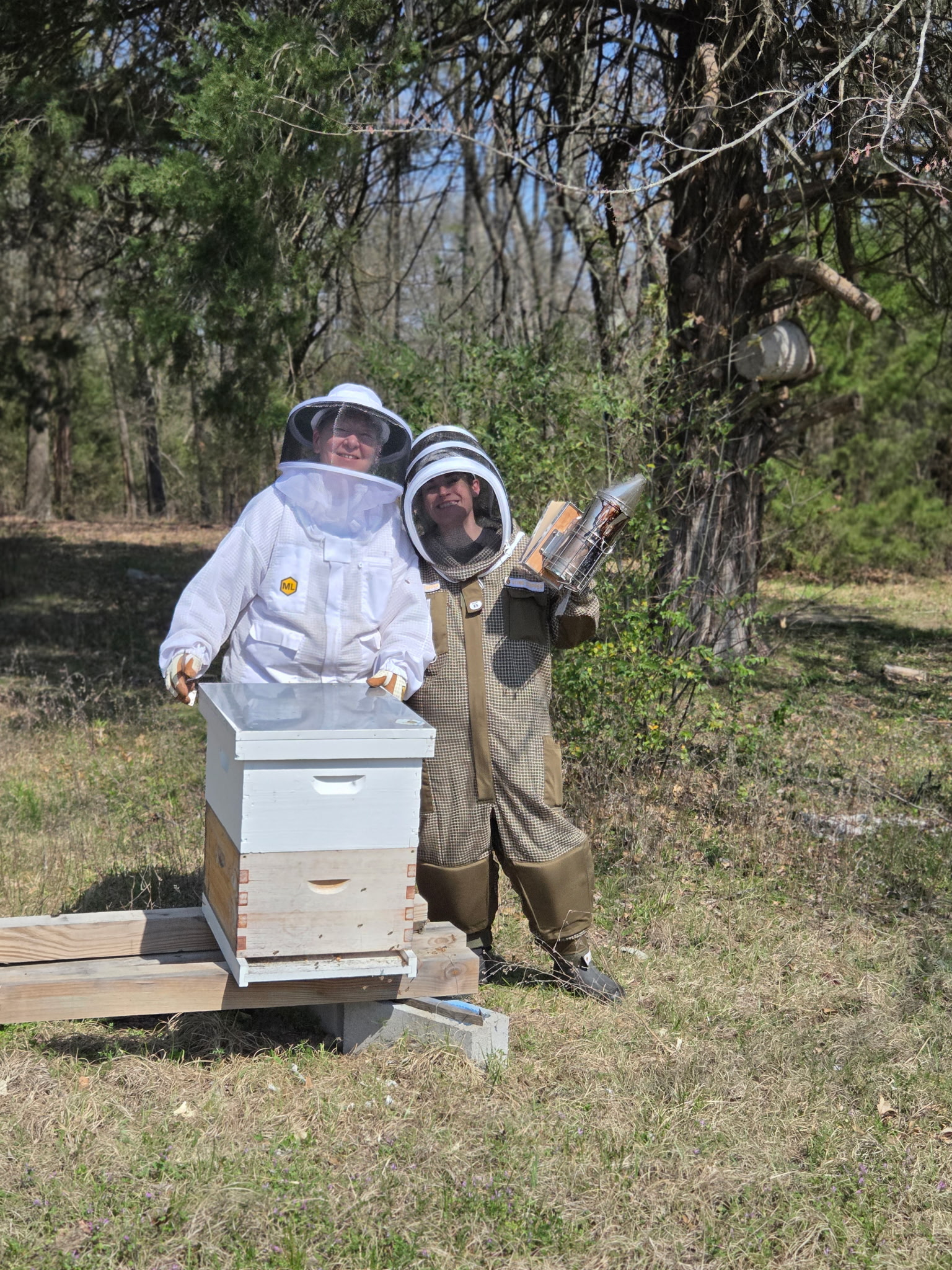
If this post resonated with you — whether you’re a nurse, a caregiver, a first responder, or simply someone who is carrying more than they can hold right now — we would love to hear from you. At Magee Meadow Apiary, we believe that the hive has something to offer all of us. We are not a formal program. We are just two beekeepers in Northeast Texas who know what it means to be healed by something small and extraordinary.
Reach out to us through our contact page or find us on Facebook and Instagram. We are always happy to talk bees, answer questions, or just listen to your story.
You spent years showing up for everyone else. You are allowed to show up for yourself now. 🍯
With deep respect for every nurse who ever showed up anyway,
Magee Meadow Apiary — Northeast Texas