Your Free Northeast Texas Beekeeper’s Forage Guide Is Here
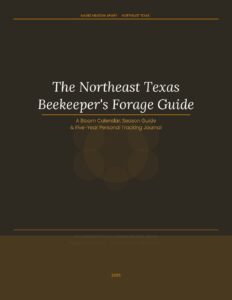
A bloom calendar, season guide, and five-year personal tracking journal — from Magee Meadow Apiary
One of the questions we hear most often from beekeepers in our area is some version of the same thing: how do I know what’s blooming, when to expect it, and what my bees are doing at any given point in the year?
We asked ourselves the same questions when we started out. The answers came slowly, season by season, through years of watching the land and paying attention to what the bees were telling us. This guide is our way of sharing everything we’ve learned — so you don’t have to figure it all out from scratch. 🐝
What’s Inside the Guide
This is a 24-page digital booklet designed for both new and experienced beekeepers in Northeast Texas. It prints beautifully on any home printer, and reads just as well on a screen or tablet. Here’s what you’ll find inside:
- The Full-Year Visual Forage Calendar — a two-page spread showing every major bloom in Northeast Texas, month by month, with color-coded bars for trees, wildflowers, vines, and invasive species
- Eight Seasonal Deep-Dives — from the first henbit of late January all the way through the goldenrod of October, each section covers what’s blooming, what your colony is doing inside the hive, and what actions you should be taking as a beekeeper
- The Summer Dearth Section — because knowing how to protect your hives through July and August is just as important as knowing when the tallow flows
- A Quick Reference Chart — all 21 forage plants, bloom dates, nectar and pollen ratings, and flow strength in one compact printable page you’ll flip to constantly
- Five Years of Annual Bloom Tracker Pages — the feature I’m most proud of. One page per year, with rows for every key forage plant and columns for first bloom, peak bloom, end date, a 1-4 strength rating, and notes. Fill it in with a pen every season and over five years you’ll have something no general guide can give you: a personal record of your own land’s unique forage rhythm
A Note About the Tracker
Every forage guide — including this one — reflects regional averages. But your bees aren’t foraging on a regional average. They’re foraging on the trees in your pasture, the dewberry vines along your fence row, the tallow grove down the road from your hives. Your microclimate is yours alone.
The tracker pages are how you build that personal knowledge over time. Print them out at the start of each season, keep them on a clipboard in your bee yard, and take thirty seconds to jot a date when you notice something blooming. Do that for five years and you’ll have a document that is genuinely irreplaceable — something your future self will be deeply grateful for. 🍯
Download Your Free Copy
This guide is completely free. No email required, no sign-up, no strings attached. Just click the button below and it’s yours. Print it, share it, pass it along to every beekeeper you know in Northeast Texas. That’s exactly what it’s here for.
PDF · 24 pages · 8.5″ × 11″ · Prints on any home printer · Free to share
This Guide Is for You If…
- You’re new to beekeeping in Northeast Texas and want to understand the forage calendar before your first full season
- You’ve been keeping bees for years but have never had a systematic way to track bloom dates on your property
- You’ve lost colonies to the summer dearth and want to understand how to see it coming and prepare
- You want to know exactly when to add supers, when to harvest, and when to start worrying about winter stores
- You simply want to understand what your bees are doing and why — season by season, bloom by bloom
We hope this guide serves you and your bees for many seasons to come. If you find it useful, please share it freely — pass it along to your local beekeeping club, post it in your beekeeping Facebook groups, or hand it to anyone who is just getting started. The more beekeepers who understand the forage year in our region, the better it is for all of us and for our bees.
And if you ever have questions, want to talk bees, or just want to know when our next honey harvest is available — you know where to find us. 🐝🍯
With warmth from the bee yard,
Magee Meadow Apiary — Northeast Texas