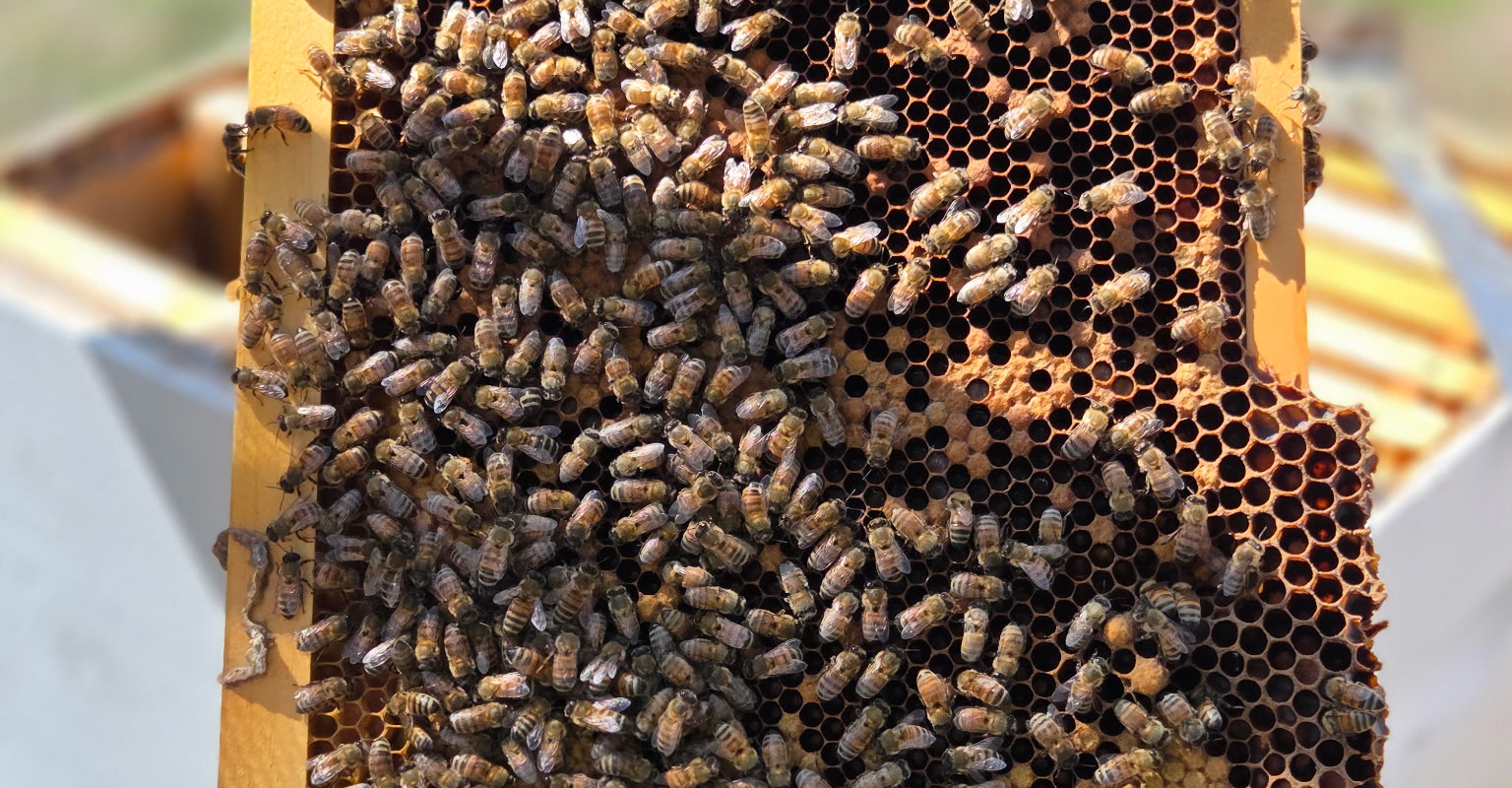
Every year in the bee yard is its own story. Some years that story is a generous one, supers filling up fast, bees coming home heavy, jars lined up on the shelf. This year, the story was more complicated. And I think it’s worth telling honestly.
If you kept bees in Northeast Texas this spring, you already know what I’m talking about. The rain came early and it came hard, and it kept coming. What should have been our big tallow flow season turned into something a lot more uncertain, and now, heading into summer, our hives are carrying that weight right into the dearth. Let me walk you through what happened, what it means for our bees, and what we’re doing about it here at Magee Meadow.
🐝 What Spring 2026 Looked Like on the Ground
Spring in Northeast Texas is supposed to build toward a crescendo, the early bloomers feeding the colony through March and April, the population surging, and then the tallow trees doing what they do: exploding with bloom from mid-May into late June and filling supers faster than you can add them. That’s the plan, anyway.
This year, the rain had its own plans. The spring of 2026 brought wave after wave of unsettled, stormy weather to our corner of Northeast Texas. By early April, KSST Radio in Sulphur Springs was already reporting that Hopkins County — our neighbor just up the road on I-30, was dealing with persistently damp ground conditions and what they described as a continuing “pattern of unsettled spring weather.” It never really let up from there.
By late April, a significant severe weather system rolled through North Texas bringing flash flooding and tornado warnings across the region. May kept the pressure on, with storm systems lining up one after another. The National Weather Service out of Fort Worth recorded that by the last week of June, rainfall across North Texas had already hit more than 8 inches for the month alone, against a historical average of just under 3.4 inches. That’s nearly two and a half times what we’d normally expect, and nearly all of it fell during or just before our critical tallow bloom window.
I want to be clear: what we experienced here along the I-30 corridor was not the catastrophic Hill Country-style flooding that’s made headlines elsewhere in Texas this summer. Our version was steadier, more persistent, the kind of spring where you’d get a few half-decent days, think the pattern was finally breaking, and then watch another line of storms roll in off the south. Week after week. Right through the tallow bloom.
🐝 What Heavy Rain Does to the Nectar Flow (And It Isn’t Pretty)
Here is what most beginning beekeepers don’t fully understand: nectar is delicate. It is produced in tiny glands inside flowers, and it doesn’t take much to disrupt the process. When we talk about a “honey flow,” we are talking about a very specific intersection of conditions, the right plants blooming, the right temperatures, and dry enough weather for the bees to fly and the flowers to hold their nectar.
Heavy, repeated rain disrupts that equation in several different ways at once:
- Rain physically washes nectar out of flowers. The tallow tree’s small catkin-like blooms are especially vulnerable to repeated downpours, once that nectar is washed out, it’s gone. The flower doesn’t just reload overnight.
- Bees simply cannot fly in heavy rain. Our foragers are grounded every time a storm rolls through. During a bloom window that only lasts a few weeks, every lost foraging day matters enormously. The British Beekeepers Association has noted that colonies need at least four to five hours of dry, warm flying weather each day during bloom periods just to produce surplus honey. This spring, we had entire weeks where that window barely existed.
- Rain dilutes the nectar that does make it into the hive. Even when bees can fly in the aftermath of rain, the nectar they bring back has a higher water content than usual. That means the bees have to work significantly harder and longer to evaporate it down to the 18% moisture level that makes shelf-stable honey. With high post-rain humidity in the air on top of everything else, that evaporation process slows even further.
- The bloom window doesn’t wait. This is the hard truth that makes a wet tallow season so difficult to recover from. The tallow trees bloom when they bloom. Whether the bees get to capitalize on that bloom — whether we as beekeepers get to harvest any of that, depends entirely on the weather cooperating during those few weeks. When it doesn’t, you simply don’t get that opportunity back until next year.
I’ve been a beekeeper long enough to know that you make peace with what the season gives you. But I’m not going to pretend this spring wasn’t a genuinely tough one for our hives.
🐝 What This Means for the Honey Harvest
I want to be straightforward with you here, because I think honesty is what this community deserves: our honey harvest this year is going to be lighter than a normal year. That is almost certainly true across much of Northeast Texas, not just at Magee Meadow.
The tallow flow is our main event. It’s the bloom that, in a good year, fills supers in a matter of days and accounts for the majority of what we’re able to harvest and share with you. When that flow is repeatedly interrupted by storms over the course of several weeks, the result is a significantly reduced honey crop, even when the trees bloomed beautifully and the colony population was strong.
We are not alone in this. Talk to any beekeeper in our part of the state right now and you will hear the same story. The land was generous with water this year. It was less generous with dry, warm bloom days.
What honey we do have will be every bit as raw, unfiltered, and full of the flavor of this particular East Texas land as it always is, because that never changes. But if your usual order is smaller this year, or if we sell out faster than normal, now you know why. Our bees worked incredibly hard for what’s in those jars.
🐝 And Now the Summer Dearth
If the spring story was complicated, the summer chapter adds its own challenge. Because right on the heels of a reduced flow, our bees have now walked into the thing that Northeast Texas beekeepers plan for and worry about every single year: the summer dearth.
From July through August, the forage here essentially disappears. The tallow is done. The spring wildflowers are long gone. The ground bakes under Texas summer heat, and the only blooms left are scattered and sparse — not enough to sustain a colony, and certainly not enough to add to stores. It’s a natural part of our forage year, and in a normal year, a hive coming out of a strong tallow flow has enough honey stored to bridge through dearth comfortably. The math works out.
This year, that math is tighter. Colonies that didn’t get to put up as much during the spring flow are heading into dearth with less cushion than we would like. And the heat compounds everything, when temperatures climb above 95°F, bees spend enormous energy just managing the temperature inside the hive, which burns through their food stores faster and stresses the colony in ways that can have lasting effects.
Here is what the dearth looks like inside a hive that is feeling the pressure:
- Increased defensiveness. Bees that were calm and easy to work with during inspections earlier this season may be noticeably crankier right now. This is not a personality change, it’s a survival response. Research has actually confirmed that colonies experiencing nutritional stress become measurably more defensive. They are protecting what little they have left.
- Robbing behavior. This is one of the most dangerous dynamics of dearth season. Strong colonies will actively attempt to steal honey from weaker ones. What starts as a few scout bees investigating a neighboring hive can turn into a full robbing frenzy that strips a weaker colony of its stores within hours, and once robbing begins, it often ends in fighting, colony collapse, and sometimes even the loss of the queen. If you see bees fighting at your hive entrance or unusual activity around the box seams, address it immediately.
- Reduced forager traffic. An obvious sign, but one that’s easy to misread. If your usually-busy entrance has gone quiet on a warm afternoon, resist the urge to open the hive and investigate. Idle bees in a dearth are conserving energy. Every unnecessary inspection uses resources the colony needs to hold onto.
- Varroa pressure rising. The dearth period is also when varroa mite populations tend to accelerate. With brood cycles compressing and fewer bees to keep mite loads in check, this is the time of year when mite counts can climb fast. If you are not monitoring, now is the moment to start.
🐝 What We Are Doing at Magee Meadow Right Now
We are not throwing our hands up. We are watching closely and managing accordingly. Here is what our current practice looks like as we move through the dearth:
- Reduced entrances on all hives. A smaller entrance is a defensible entrance. We have narrowed them down to make it harder for robbers from other colonies, yellowjackets(which are out in force during dearth), to get in.
- Fresh water close to the hives. Bees use water to cool the hive through evaporation, and in Texas summer heat, they need a lot of it. We keep multiple reliable water sources within easy foraging distance of the apiary and refill them daily.
- Keeping inspections brief and infrequent. Every time we crack open a hive during dearth, we are using the colony’s energy, exposing their honey to the smell of nearby bees, and potentially triggering robbing. We are limiting ourselves to quick, purposeful checks and only when there is a specific reason to go in.
- Monitoring stores carefully. If we see that a colony’s honey stores are dropping below what we feel comfortable with, we will supplement with sugar syrup rather than let them hit a critical point. Feeding during dearth is a last resort, but it is the right move when stores are truly low.
- Watching the varroa counts. We are doing alcohol wash counts on our colonies and will treat if thresholds are reached. A colony stressed by dearth and running high mite numbers is a colony at serious risk heading into fall.
🐝 The Light at the End of the Summer: What Goldenrod Could Mean for Us This Fall
Here is what keeps us going every July and August, and this year I mean it more than usual: goldenrod is coming.
Every beekeeper in Northeast Texas who has made it through a hard summer knows the particular relief of spotting that first spray of yellow along the fence line in late September. It means the dearth is almost over. It means the bees are about to get back to work in a serious way. And this year, with our colonies heading into fall carrying lighter stores than usual, that goldenrod flow isn’t just welcome — it may be one of the most important things that happens in our apiary all season.
When to Watch For It
In our part of East Texas, goldenrod typically begins showing up in late September and hits its stride through October, often lasting right up until the first frost. The Pineywoods Beekeeping community — our neighbors to the south — specifically note October as their major goldenrod flow month, paired with a variety of other fall wildflowers that bloom in sequence. The flow can be genuinely exceptional in a good year, and it can last weeks. That is a meaningful window for colonies that need to rebuild.
Watch for the first blooms on roadsides and in unmowed fields, particularly along fence lines and anywhere the ground stays a little moister. That is your signal. When you start seeing goldenrod, your bees are likely already on it and it is time to think about getting supers back on if your colonies are strong enough to need the space.
A Silver Lining Hidden in All That Rain
Here is something worth holding onto as we sit in the middle of this hard summer: all of that spring rainfall that caused us so much grief during the tallow flow? It soaked deeply into the ground. And deep soil moisture is exactly what wildflowers, including goldenrod and asters, need to produce a strong fall bloom.
The Lady Bird Johnson Wildflower Center noted earlier this year that East Texas, specifically because of its higher-than-average spring rainfall, was better positioned for fall blooms than many drier parts of the state. Plants that got good moisture early in the growing season have the root system and the energy reserves to bloom more prolifically in fall. Research on goldenrod also confirms that adequate soil moisture established earlier in the growing season directly supports the plant’s flowering potential later in the year, the opposite effect of drought, which can suppress goldenrod bloom significantly.
We cannot promise a record goldenrod year. Weather will still have the final word, as it always does. But we have good reason to believe the land has been storing up something for us, and we are cautiously hopeful.
Goldenrod Isn’t Coming Alone
One of the things I love most about fall forage in East Texas is that goldenrod rarely shows up by itself. It comes as part of a wave of fall bloomers that together make this a genuinely significant forage season for our bees. Alongside goldenrod, watch for:
- Asters — Blooming alongside and after goldenrod, asters are excellent for both nectar and pollen. They are often the last significant bloom before frost and can extend the fall flow well into November in a warm year.
- White mistflower — A native Texas beauty that bees absolutely work to exhaustion. It tends to show up in the shadier, moister edges of fields and along creek banks — exactly the kind of landscape we have a lot of in our corner of Wood County.
- Maximilian sunflower — A tall, bold fall bloomer that can produce both nectar and pollen. Where it grows in abundance, it can be a meaningful addition to the fall flow.
- Frostweed — Blooms late and is often the very last thing bees can work before the first freeze ends the season. Every late warm day counts.
Together, this fall palette can carry our hives from late September all the way to first frost — which in Northeast Texas often doesn’t arrive until late November or December. That is a generous window, and it is one of the reasons our region is genuinely good bee country despite the challenges summer throws at us.
What the Fall Flow Can Do for a Colony Coming Out of a Hard Summer
There is a concept in beekeeping called “fat bees” — the winter bees that a colony raises in late summer and fall, which are physiologically different from summer foragers. They have larger fat bodies, longer lifespans, and are specifically built to carry the colony through winter. A strong fall flow allows colonies to raise a good population of these winter bees well-nourished and in good numbers. After a summer like this one, that matters enormously.
A solid goldenrod flow can help our colonies do several things at once: rebuild honey stores that dearth has depleted, raise the fat bees that will be the colony’s survivors through winter, and restore the overall population strength and morale (and yes, I do think bees have something like morale) of hives that have been in conservation mode for two months.
It will not erase a difficult spring and summer. But it can absolutely set our colonies up to go into winter in far better shape than they are in right now. And for beekeepers, that means everything.
How We’ll Be Getting Ready
As we watch August wind down and September approach, here is what we will be doing at Magee Meadow to make sure our colonies are positioned to take full advantage of whatever the fall flow offers:
- Completing any varroa treatments before the fall flow begins. We want those treatments done and any waiting period completed before goldenrod opens up, so the winter bees raised during the fall flow are raised by a healthy, low-mite colony.
- Assessing colony population and combining if needed. A colony that is too small to capitalize on the fall flow is better combined with another colony to make one strong unit. Two struggling hives rarely become two thriving hives on their own. One well-supported colony has a much better chance.
- Having supers clean and ready. We are not assuming there will be a surplus harvest from goldenrod, but we are not going to be caught unprepared if it turns out to be a strong flow. Clean supers ready to go means we can add them the moment a colony needs the space.
- Easing back on entrance reducers as robbing pressure drops. Once the fall flow begins in earnest, robbing pressure typically lessens as there is plenty for everyone. We will watch for that shift and give our colonies back their full entrances as the season warrants it.
We will be watching for goldenrod the way farmers watch for rain. With patience, with hope, and with a very specific kind of gratitude that only comes from having waited a long time for something good.
A Note to Our Customers and Community
Beekeeping has a way of humbling you. Every year. This is one of those years, and we are not pretending otherwise. The bees are healthy, they are being cared for, and they will come through this. But if you’ve been wondering why 2026 honey looks different – lighter in volume, perhaps with limited availability – now you have the full picture.
We are grateful for every person who chooses to support a small local apiary like ours. You are part of why we keep doing this work, even in the hard years. Especially in the hard years.
If you have questions about our current honey availability, or if you just want to talk bees and weather with someone who understands, we are always here. Drop a comment below, send us a message, or find us on Facebook and Instagram. This community means everything to us.
With love from the bee yard,
Suzanne & Nicki — Magee Meadow Apiary