What really happens when a woman picks up a hive tool for the first time — the fear, the wonder, the honey, and the friends you never expected.
From the Hive — Vol. 1
I Signed Up for a Hobby. The Bees Had Other Plans.
You don’t have to use deeps for brood.
What really happens when a woman picks up a hive tool for the first time — the fear, the wonder, the honey, and the friends you never expected.
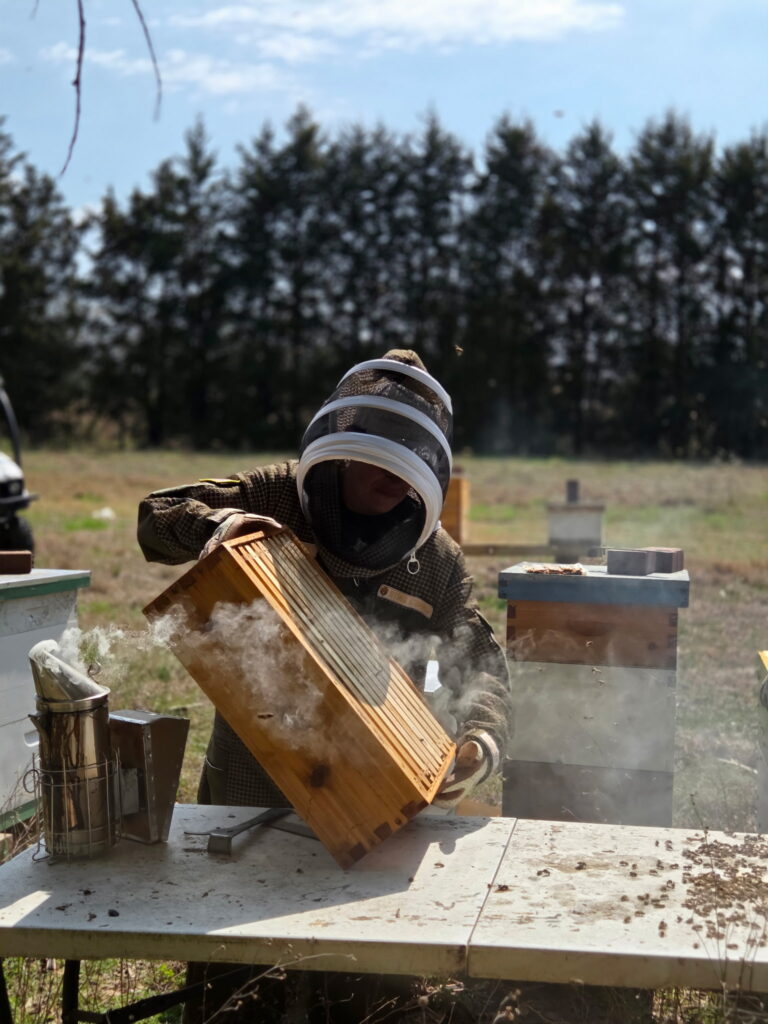
Let me paint you a picture. It’s a Saturday morning in East Texas, the air already thick with the kind of heat that makes you question your life choices. I’m standing in front of a wooden box that is — I am not exaggerating — vibrating with the sound of fifty thousand tiny, opinionated roommates. I have on a brand-new bee suit that I ordered at midnight from the internet. My hands are shaking inside gloves that are two sizes too big. And my wife Nicki, who agreed to this adventure alongside me, is standing a very safe fifteen feet back, squinting at me through her veil like, you opened the lid, so this is officially your fault.
That was a few years and thirty-two hives ago.
If you’re a woman who has ever been curious about keeping bees, this post is for you. Not the glossy version where everything is golden light and slow-motion honey pours. The real version. Because nobody warned me what I was getting into — and also nobody warned me how completely, embarrassingly, wonderfully in love with it I would become.
Why I Started (And Why It Had Nothing to Do with Honey)
Nicki and I are both full-time nurses — Monday through Friday, eight to five, the kind of jobs where you pour your whole self into other people’s hard days. After thirty-plus years at the bedside, I’d learned a lot about caring for people. What I hadn’t quite figured out was how to care for myself in a way that felt like more than just collapsing on the couch with Netflix.
Beekeeping crept up on me the way the best things usually do. A neighbor had hives. I started reading. Then I couldn’t stop reading. There’s something about the colony — the quiet logic of it, the way fifty thousand individuals move as one living thing with one purpose — that felt, honestly, like medicine. Here was something ancient and honest and completely indifferent to hospital billing systems.
I didn’t start with one or two hives, I went all in with 10 nucs our first year. I have a tendency to become obsessed with things I love, and I knew that I wanted an apiary full of hives, bees, and honey. Very quickly Nicki decided we needed a name, and Magee Meadow was born.
“There’s something about standing at a hive in the early morning — just you and the bees and the sound of Northeast Texas waking up — that resets something deep inside you that working in a stressful environment every day just undoes”
Let’s Be Honest: It Wasn’t Easy at First
Here’s what the beekeeping books don’t always tell you: being a woman in this hobby comes with its own particular set of hurdles, and they have nothing to do with the bees.
The fear is real — and that’s okay
Nobody is born unafraid of stinging insects. Fear is not a character flaw. It’s a starting point. Every confident beekeeper you admire was once you.
The “she doesn’t really know” look
Show up at a bee supply store or a local bee meeting as a woman, and sometimes you’ll feel the room sizing you up. Stand your ground. You belong there.
Finding the time
Between two full-time nursing jobs and thirty-two hives, time management is not optional. The bees taught us to work smarter, plan ahead, and ask for help.
The learning curve is steep
Varroa mites. Swarm prevention. Queen laying patterns. Brood diseases. It’s a lot. Give yourself grace and two full seasons before you expect to feel fluent.
The physical demands
Hive boxes are heavy, especially full of honey in July. This is not a dainty hobby. But you’d be surprised what your body figures out when your heart is in it.
East Texas summers
Working bees in a full suit when it’s 97° outside is its own special challenge. Hydrate before you suit up. The bees will still be there when you take a break.
I won’t pretend those things disappeared. Some of them are just part of the deal. But here’s the truth: every single challenge has given me more than it cost me. I am more confident, more patient, and more curious than I was before I kept bees — and I spent thirty years at a bedside, so that’s saying something.
• • •
What the Bees Did to Our Garden
Nothing prepared me for this part.
Our little piece of Northeast Texas was always pleasant — good soil, decent gardening weather when the rain cooperates, a vegetable patch that produced faithfully if not spectacularly. Then we put in the bees, and the whole thing shifted. I’m not being poetic here. I mean that the actual volume of fruit on the trees went up. The tomatoes got ridiculous. The squash started producing like it had something to prove. Neighbors started asking what we were doing differently.
Honeybees are among the most effective pollinators in the world, and when you place a colony near your garden, you’re not just keeping bees — you’re building an invisible infrastructure that strengthens every flowering plant on your property. Fruit trees, vegetables, wildflowers, herbs: all of it responds. That first summer, I stood in our garden and thought, oh. This is what it’s supposed to look like.
We’ve since planted specifically for our bees — clover, lavender, native wildflowers, and patches of things they love that we’d never have grown otherwise. The garden and the apiary became one living thing. They take care of each other, and together they take care of us.
• • •
The Sweet Part (You Knew We’d Get Here)
Raw honey from your own hives is nothing — and I mean absolutely nothing — like what you’ve been buying at the grocery store. I say this as someone who grew up eating perfectly respectable store honey and thought I understood what honey was. I did not understand what honey was.
Our honey reflects this specific corner of Northeast Texas. The wildflowers our bees visit, the trees they work, the season — all of it is in the jar. Every harvest tastes like exactly where we live, and that is a remarkable thing to be able to give someone.
But honey is just the beginning. Once you have a hive, you have access to a whole world of products that your bees make incidentally, while doing what they do:
Raw wildflower honey
Beeswax for candles & balms
Lip balms & skin salves
Nucleus colonies for new beekeepers
Locally mated queens
Craft mead (on our horizon 🍯)
There is something deeply satisfying about creating something that began as a box of bees and ended up as a jar of gold you grew yourself, right here in East Texas. We give it as gifts. We sell it locally. And honestly? We eat a little more of it than we probably should.
• • •
The Part Nobody Told Me About: The People
I expected to love the bees. I did not expect to love the beekeepers.
The beekeeping community — at least the corner of it we’ve found here in Northeast Texas — is something genuinely special. These are people who will drive forty-five minutes to help you hive a swarm at eight in the morning. Who will spend an hour on the phone talking you through a queen problem. Who share jars of honey and opinions about varroa treatments with equal enthusiasm.
Women especially are finding each other in this space. There are more of us than you might think, and we are fiercely supportive of one another. I’ve made real, lasting friendships through beekeeping that I would never have predicted when I ordered those first hive boxes. There’s something about shared obsession that bypasses small talk and goes straight to the good stuff.
If you’re ever lonely in this hobby — find your local bee club, go to a meeting, show up at a hive inspection. You’ll walk in a stranger and leave with people who will absolutely text you a photo of weird comb at ten o’clock on a Tuesday night, because that’s just what we do.
• • •
From Two Nurses Who Are Still Figuring It Out
Nicki and I both still work full-time. We’re still nurses — we love being nurses — and that means our hives get managed on evenings and weekends, in between hospital stories and the particular kind of tired that comes from a job where you actually matter. Thirty-two hives is not a small operation for two people with Monday through Friday jobs. Some weeks it’s a lot.
But we’ve never once stood at a hive on a Saturday morning and wished we were somewhere else.
That’s the thing about beekeeping. It asks a lot of you, and it gives back more. It will humble you, puzzle you, occasionally sting you, and then — on a golden afternoon when you pull a full frame and smell that warm wax and nectar and watch the bees move with their unhurried purpose — it will make you feel more present than almost anything else in your life.
We started Magee Meadow Apiary because we fell in love with something and wanted to share it. These bees, this land, this messy and joyful and never-boring life we’ve built around thirty-two hives in Northeast Texas. We hope you’ll stay a while.
And if you’ve ever thought about keeping bees — even just a flicker of curiosity — I hope this gave you a little more reason to say yes.
With love from the meadow,
Suzanne & Nicki
Magee Meadow Apiary — Northeast Texas
🐝 Join Our Hive
Get the Meadow in Your Inbox Every Month
Seasonal hive tips, honey recipes, and behind-the-scenes life with 32 hives. Honest stories from two nurse-beekeepers in Northeast Texas who are figuring it out alongside you.Subscribe — it’s free
No spam. No algorithms. Just one letter a month, straight from the meadow.
© 2026 Magee Meadow Apiary — Northeast Texas • Made with love and a little bit of propolis • Privacy Policy